
Author: advpress

  • Make Them Go Away

    Make Them Go Away

    Clint Eastwood, Christopher Reeve & the Case Against Disability Rights

    Nonfiction by Mary Johnson.
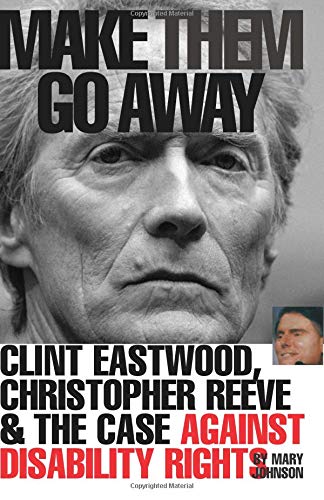
    In the spring of 2000, actor Clint Eastwood took on the 10-year-old Americans with Disabilities Act. His Mission Ranch hotel in Carmel, California, had been sued for access violations under the law, and he’d been slapped with a lawsuit he’d never seen coming, he said….
    “What happens is these lawyers, they come along and they end up driving off in a big Mercedes,” Eastwood told reporters, “and the disabled person ends up driving off in a wheelchair.” In the days leading up to the hearing, Eastwood appeared on the talk shows Hardball and Crossfire; he was covered in a Fox News Special. The National Journal quoted him. Columnists covered his comments. Newsweek used the “Mercedes” quote on its “Perspectives” page. The seasoned Hollywood actor had his script and he stuck to it: He wasn’t against disabled people. He wanted to help disabled people, who were being preyed on by moneygrubbing lawyers. The law was the problem; had been all along. The law needed to be fixed. …

    — from Make Them Go Away

    A gripping read and an awakening.
    — Lucy Gwin, editor, Mouth magazine.

    “Imagine an African American’s voting rights withheld until he or she proved 100 percent African American descent, or a woman having to sue her employer to get a women’s restroom in the workplace. Outrageous as those scenarios seem, their like is commonplace in the lives of the disabled, Johnson says, because of widespread misinterpretation and misapplication of the Americans with Disabilities Act (ADA). She points out numerous flaws in the law, beginning with its title (she prefers that of the British analog, the Disability Discrimination Act) and including the fact that it is enforceable only via lawsuit, putting rights seekers in an adversarial position, and that it contains an escape clause permitting noncompliance if accessibility causes a business “undue hardship.” The disabled person’s difficulties aren’t, however, confined to the law, and the roots of conflict over disability rights reach deep into personal prejudices and national values. Bit-by-bit Johnson deconstructs arguments against disability rights from the likes of Clint Eastwood as well as more ordinary folk, and she constructs powerful reasons why we all benefit from inclusion.” –Booklist

    “Everyone cares for disabled people, right? What they don’t care for are genuine civil rights for disabled people. MARY JOHNSON tells the tortuous, enraging story of how Congress enacted a law that instead of protecting against discrimination has turned ‘the disabled’ into a political punching bag.” –William Greider, national affairs correspondent, The Nation.

    “You really need to read this book. If it makes you grit your teeth, read it anyway. It will help you explain to others why we need to change our way of thinking about disability rights in general and the Americans With Disabilities Act in particular.” — David P. Rundle, The Wichita Eagle

    Make Them Go Away “reveals the animus against disability underlying all those sweetly written op-ed pieces, and … challenges us to oppose the mindset that puts the civil rights of all Americans at the mercy of the marketplace.” — Douglas Lathrop, New Mobility

    “In challenging us to imagine a more accessible living environment, Johnson outlines why we all have a stake in creating such a society,…it’s the one minority that anyone can join in an instant… Viewed this way, accessibility becomes a matter of self-interest for everyone. [I]f America is to live up to its promise as a place of opportunity for all, then this is a discussion we desperately need to have. Johnson’s thoughtful, carefully argued book is an important contribution to that dialogue, and an excellent place to start.” — Martha Barnette, The (Louisville) Courier-Journal

    “I found Make Them Go Away invaluable in forming our arguments to convince Governor Gray Davis, Attorney General Bill Lockyer and the Medical Board of California to stop the Medical Board of California v, Hason appeal to the U.S. Supreme Court.” — California activist HolLynn D Lil.

    296 pp. Paperback
    $16.95
    ISBN 097211890X | Copyright 2003
    Print (external link) | Kindle (external link) | ePub (external link)

  • Representing Disability in an Ableist World

    Representing Disability in an Ableist World

    Essays on Mass Media

    Nonfiction by Beth A. Haller, Ph.D.

    Towson University journalism professor Beth A. Haller’s 20 years of research into disability and mass media inform this one-of-a-kind collection on advertising, news, entertainment television, film and Internet new media. Ideal for disability studies students and researchers as well as disability activists.

    213 pp. Softcover.
    $24.95
    ISBN: 0-9721189-3-4
    Copyright 2010
    Buy online (external link) | eBook-Kindle edition (includes text-to-speech) (external link) | ePub (external link)

  • Getting Life

    Getting Life

    Fiction

    by Julie Shaw Cole.

    ORDER BOOK (external link, opens in a new tab)

    “That light hits the side of the red roof at a different time each afternoon. I sit in the same place by the window every day. This window is on the other side of the street from that red roof. And I watch the light change just slightly each day, brushing back the shingles into shade, like gray paint rubbed into red.

    “There are pictures I remember in a book, churches, all alike, yet all different. There is one fat old soft chair. I am propped up on folded clothes and an old raggy pillow. Aunt Jo puts that book in my lap and leaves me to go do what she does. . . .”

    From Getting Life.

    303 pp. Paperback. | Audiotape. | eBook
    $16.00
    ISBN 0962706485 | Copyright 2000
    Paperback (buy online) (external link, opens in a new tab) | Kindle (external link) | ePub (external link)

    REVIEWS

    Getting Life does what few others do. It gets into the mind of the primary character in a way that draws you into her world so completely you don’t want to let her go.
    What makes this so interesting a task is that as the novel begins the protagonist, Emily, is a non-verbal, nursing home resident who has sat like a lump on a borrowed wheelchair for most of the past seventeen years. But Emily is not a lump; she is a thinking, feeling human being who has never had the opportunity to show her stuff. Raised by an aunt and uncle after her mother was killed in an accident Emily is subjected to tender care from her uncle and abuse and despair from her aunt. When both these relatives die, she is dumped into the nursing home where she believes she’ll stay forever.

    In one of the novel’s many ironies, it is neglect and abuse that changes Emily’s life. She is so badly neglected by a member of the nursing home staff that she finds herself in a hospital-and that turns out to be the best thing that could have happened for her. An empathetic doctor sees that there is more to Emily than meets the eye and begins a course of liberating Emily from the nursing home.

    This doesn’t happen overnight. Just like in real life, Emily has lots of time on her hands in the nursing home, which has been home for many years. She’s not that eager to just up and leave. And how can she, she wonders, since she doesn’t speak; she can’t walk, no one outside of the nursing home will take care of her and on and on. Emily shares her struggles, her pains, her triumphs with us on the path to freedom with which the book concludes.

    This is a triumphant story, but more importantly it’s a fascinating one which takes us into the minds of several nursing home residents, touches on the lives of several staff members of an independent living center and includes an ADAPT-like group for emphasis. As I read, my only regret was that not every town has an independent living center like the one in the book-patient, knowledgeable, resourceful, and persistent.

    The highest praise I can give the book is this. Reading it was the last thing I did last night and finishing it was the first thing I did upon waking up in the morning. I couldn’t wait to see how Emily began her life. GETTING LIFE has joined Jean Stewart’s THE BODY’S MEMORY and Anne Finger’s THE BONE TRUTH as the best novels I have read about the daily experience of disability. It should be in every CIL and anyone interested in the state of disability consciousness in the new millennium should find a copy.

    GETTING LIFE does an incredible job of acknowledging too often unheard voices. Now it’s up to us-the reading public-to see that GETTING LIFE finds a home throughout public and private libraries all over the world.

    –Steven E. Brown, Institute on Disability Culture

    It is fiction, but it likely describes the lives of many persons with disabilities. The reader should not fear, however, that this is a preachy or depressing narrative about the perils of nursing home life. The story is written from Emily’s perspective, and Emily is very funny, imaginative and downright spunky. Her unexpressed thoughts will move the reader to laughter as often as tears.

    In addition to being a great read, this book needed to be written to call attention to the Emilys in institutions far and near and to gather backing for initiatives to support these folks in their efforts to live in the community and enjoy a more independent and fulfillling lifestyle. As Emily vividly demonstrates, people with disabilities enhance our lives by being in our midst.

    –Reba Pierce, Kentucky Monthly

  • Safely Home

    Safely Home

    A Profile of a Futures Planning Group

    Compiled by Betty Atherton and Julie Shaw Cole.

    Edited by Julie Shaw Cole.

    Betty was up against the wall of her son’s disabilities. Organizations and agencies in her community hadn’t responded to her repeated pleas for support. She had knocked on every door and was about to give up when she found Jo Ann Boyle. Jo Ann had new ideas — and new ways to realize them.

    At first Betty was baffled by Jo Ann’s technique of “blank-paper planning.” But soon a fresh view of son Raymond’s potential brought her new hopes and dreams. She began to see that things could happen for him that she had never let herself even consider. Betty and her family brought high energy, unconditional love, and warm hospitality to the “futures planning” group that grew up around the new plans and ideas for Raymond. The group set out to listen carefully to what Raymond wanted and found ways to see those “wants” fulfilled.

    Some of Raymond’s group members were pioneers in the new concepts of futures planning and supported living in Kentucky. With determination and a delicate sense of timing, they worked together with Betty and her family to make Raymond’s dreams real.

    States are now implementing through consumer-directed programs for people with disabilities what Raymond’s group realized for him. It took patience, creativity, dogged stubbornness, an ability to dance with bureaucracies, and a taste for fried fish. Raymond’s story can show others how this CAN be done today.

    236 pp. Paperback.
    $20.00
    ISBN-13: 978-09721189-2-7 | Copyright 2008
    Order today – exclusively from amazon.com (external link, opens in a new tab)

  • To Ride the Public’s Buses

    To Ride the Public’s Buses

    Edited by Mary Johnson & Barrett Shaw.
    Photos by Tom Olin.
    Foreword by Stephanie Thomas.

    The issue may be lifts on buses.
    But what we are doing is building a movement.

    — Mike Auberger, ADAPT, 1983
    For the first time in book form . . .
    The bus battles across the nation: The national ADAPT actions. The
    protest in the streets. The legal fight. The victory . . .

    As told in the pages of The Disability Rag 1983-1990.

    200 pp. Paperback.
    $17.95
    ISBN 0-9627064-9-3 | Copyright 2001
    Buy online – Print edition (external link) | ePub (external link)

  • Byline of Hope

    Byline of Hope

    Collected Newspaper and Magazine Writing of Helen Keller

    Edited by Beth A. Haller, Ph.D.

    In Byline of Hope, Towson University journalism professor Beth A. Haller has collected Helen Keller’s writing for newspapers and magazines — articles for Good Housekeeping, Ladies Home Journal, The Atlantic Monthly, The New York Times and The Home Magazine — many of them never before reprinted until now. With introductory chapters and analysis.

    Keller’s “was the perfect message for the 20th century…that positive social change could occur.”

    Facebook logo (external link)

    335 pp. Softcover.
    $19.95
    ISBN: 978-0-9627064-1-7
    Copyright 2015

    Now available for purchase at Amazon (external link, opens in a new tab) – Paperback / Kindle editions.

  • The Ragged Edge

    The Ragged Edge

    The Disability Experience from the Pages of the First Fifteen Years of The Disability Rag.

    Anthology edited by Barrett Shaw.

    raggededge (external link)
    “The Disability Rag is the voice of a mighty revolution, and this stunning collection from its first 15 years will become an invaluable primer for anyone who wants to understand the new thinking of the disability rights movement. Here are the urgent, spirited and provocative stories that have changed the way people — disabled and nondisabled — have come to view what it means to have a disability.”
    –Joseph. P. Shapiro, National Public Radio, author of No Pity: People with Disabilities Forging a New Civil Rights Movement.

    “Reading The Ragged Edge [anthology] is like sitting in on a vigorous, sometimes funny, and often irreverent roundtable discussion of the issues that most concern all humanity, disabled and nondisabled, whether they admit it or not. Some of the voices are reflective, some sad, some furious, but none will lull you to sleep. On the contrary, you’ll feel ready to roll on out and transform the world.”SW
    — Nancy Mairs, author of Plaintext, Carnal Acts, Ordinary Time and Waist High In the World

    238 pp. Paperback. | ASCII Diskette.
    $18.95
    ISBN 0962706450 | Copyright 1994
    Paperback (order online) (external link) | Kindle (external link) | ePub (external link)

    Print out our order form

    TABLE OF CONTENTS

    Introduction (external link) … page ix

    PREFACE:
    Why We Do What We Do … page xiii

    Cass Irvin


    COMING TOGETHER

    Aphasia … page 1

    Seeking the Disabled Community … page 4

    Edward L. Hooper

    Like Squabbling Cubs … page 7

    Mary Jane Owen

    Malcolm Teaches Us, Too … page 11

    Marta Russell

    Disability Culture Rap … page 15

    Cheryl Marie Wade


    IMAGE AND IMAGES

    Survivor … page 19

    S. L. Rosen

    Thoughts on Thinking Differently … page 22

    Tanis Doe

    Boutonnieres … page 25

    John R. Woodward

    Toward a Theory of Radical Disability
    Photography … page 28

    Anne Finger

    Giving It Back … page 34

    Cris Matthews

    Questioning Continuum … page 42

    Carol J. Gill


    THIS IS OPPRESSION

    The First Taste … page 50

    Cass Irvin

    The Room of Pain and Loneliness … page 53

    Edward L. Hooper

    Disconfirmation… page 57

    Billy Golfus

    Cowboy Justice in Tiburon… page 64

    Arthur Jacobs

    Hate … page 67

    Barbara Faye Waxman

    PRIVATE MATTERS

    Public Stripping … page 73

    Lisa Blumberg

    New Insights … page 78

    Edward L. Hooper

    It’s Time to Politicize Our Sexual Oppression … page 82

    Barbara Faye Waxman

    It Ain’t Exactly Sexy … page 88

    Cheryl Marie Wade


    POEMS

    Excavation … page 91

    Kenny Fries

    Lunch Break … page 96

    Laura Hershey

    Reconciliation … page 98

    Cheryl Marie Wade

    Reading Braille … page 100

    Mary McGinnis

    White Caps … page 102

    Margaret Robison

    Thanksgiving Day Feast … page 103

    Susan McBride

    Travelling… page 104

    Katherine Simpson

    Like Walking on the Moon… page 108

    Nancy Scott

    Now and Then Again … page 109

    Susan Hansell

    Trajectories … page 112

    Brian Hartshorn

    Becoming Beautiful … page 114

    Nancy Bigelow Clark


    THE PITY PLOY

    And the Greatest of These Is Charity … page 115

    Anne Finger

    A Test of Wills: Jerry Lewis, Jerry’s Orphans and the Telethon … page 120

    Mary Johnson

    Time to Grow Up … page 131

    Julie Shaw Cole and Mary Johnson


    ADAPTABILITY AND OTHER ACTIONS

    On the Barricades with ADAPT (read excerpt) … page 137

    Mary Johnson

    Wade Blank’s Liberated Community … page 149

    Laura Hershey

    The Power of One Person … page 156

    Mary Johnson


    ARE WE BEING SERVED?

    The Do-gooder … page 165

    Billy Golfus

    Why the Nation Doesn’t Have Attendant Services … page 173

    Mary Johnson

    Auschwitz on Sesame Street … page 178

    Lucy Gwin


    LIFE AND DEATH

    Unanswered Questions … page 186

    Mary Johnson

    Suicide: Political or Personal … page 202

    Julie Reiskin

    Silence on the Psychiatric Holocast … page 208

    Steve Mendelsohn

    Springtime for Hitler … page 212

    Kathi Wolfe

    Eugenics and Reproductive Choice … page 218

    Lisa Blumberg

    It Can Happen Here … page 230

    John R. Woodward

    NOTES ON CONTRIBUTORS … page 236

    238 pp. Paperback. | Kindle | ePub
    $18.95
    ISBN 0962706450 | Copyright 1994
    Paperback (order online) (external link) | Kindle (external link) | ePub (external link)

  • Disability Awareness- Do It Right!

    Disability Awareness- Do It Right!

    Your all-in-one how-to guide: Tips, techniques & handouts for a successful Awareness Day from the Ragged Edge Online community

    Handbook edited by Mary Johnson.

    Simulation exercises — activities in which participants get into wheelchairs, tie on blindfolds or stuff earplugs into their ears to “simulate” having a disability — have become a popular “Awareness Day” event. But they’ve also come under fire from disability activists and educators, who criticize them as demeaning and inaccurate.

    Disability Awareness — Do It Right! offers you an all-in-one how-to guide from the Ragged Edge Online community, with tips, techniques and handouts for a successful Awareness Day.

    Short background articles and planning lists help you organize fun and effective Awareness Day activities that disability rights activists support.

    Concise, easy-to-read chapters show you how to carry out 6 specific types of activities, how to handle follow-up discussion and even how to spur social change.

    Appendices include resources and articles to use with Awareness Day participants.

    128 pp.Large-format paperback (8.5″ x 11″). | ASCII
    $19.95
    ISBN 0972118918 | Copyright 2006
    Paperback (external link) | Kindle (external link)

  • Making News

    Making News

    How to Get News Coverage of Disability Rights Issues

    Nonfiction
    by Tari Susan Hartman & Mary Johnson.
    Worried about anti-disability spin in the media? Fight back — make your own news! Get on the front pages, lead the newscasts, influence public debate. This how-to book gives examples, tips.

    165 pp. Paperback. | Kindle | ePub
    $10.95 | ISBN 0962706434 | Copyright 1993
    Paperback (buy online) (external link, opens in a new tab) | Kindle (external link) | ePub (external link)